Senin, 30 Juni 2014
How to Plan an Incredible Event - The Basics
The Basics of Event Planning
Detail is everything when you are planning an event. If you are planning an event, it is important to attend to detail and organization as much as possible. While event planning may seem somewhat cumbersome, it can proceed smoothly, as long as you follow a specified system of sorts. Every event has the same fundamental components, including space planning, guests tallying, amenities that you must purchase, as well as other commodities that you must attend to. With this considered, it is understandable why event planning is such as multifaceted and difficult practice for those who are not experienced in the field. However, if you truly wish to take your event to the next level, then consider the tips listed below.
Making Your Event Great
One way that you can make your event proceed smoothly is by integrating portable luxury bathrooms into the pictures. There are a number of benefits associated with renting luxury bathrooms, instead of your everyday port-a-potties. Your typical rented bathrooms may lack sophistication, quality, and proper sanitation mechanisms required to make your event a success. However, a luxury bathroom will make every guest at your event feel as if they are royalty. The key to conducting a successful event is that every guest feels the comfort and convenience of amenities in close proximity. Another reason why this particular luxury is so important is because many parents attend events with their children, and children require close access to bathrooms in close proximity. Therefore, if your guests feel comfortable enough to attend the event with their children, they will stay much longer. As you already know, hygiene is an important aspect of a human being's personal wellbeing, and that is why your guests deserve luxury bathroom rentals.
However, luxury bathrooms are not the only necessities that a large event requires. Every event needs to be properly sized, in the right venue and space, in the right atmosphere, and give the guests certain commodities, including beverages, food, music and much more. It is also critical to organize other important aspects of the event planning process, including where your guests will park, how they will enter the venue, and where they will be seated. All aspects of your event planning should be customized to your audience because the consumer is the most important facet of the prospect. If you consider the consumer's needs, your event will definitely be a great success.
The Right Amenities
As noted, certain commodities are just as critical as facilities, restrooms and the venue itself, in terms of planning an event. For instance, if you are organizing an outdoor event in harsh temperatures, you will most likely need additional products, including gazebos, tents, tables, chairs and much more. Of course, running an indoor event may reduce costs, but there will be less space for the guests to navigate. Just ensure that if you throw an outdoor event, that not only you have luxury bathrooms, but that you have protection from the weather and the climate, as well. The more comfortable that your guests feel, the more likely they are to patronize the event.
By Daniel Lee Holdeman
Sabtu, 21 Juni 2014
Tips for Planning for Portable Toilet Rentals During an Event
As an event planner, you are always facing the challenge of organising a successful event. This applies to all
areas including planning, timing and the entire function. Everything must be in its rightful place failure to which your reputation can get ruined. If you are planning an outdoor event that will take several hours, you need to ensure that people will enjoy themselves. One of the most important facilities that you need to hire is a Porta potty rental.
Portable toilet rentals will be used when people need to relieve themselves. An outdoor event that involves food and music necessitates this need. To avoid disappointment, it is important to work with a company that has references. This is a company that people trusts and whose services are timely and reliable. You can visit their website and read client reviews so that you can understand how the company operates. After this, you ask the company for personal references that you can contact for advice and a brief introduction of the services that the company offers. Here are other tips when planning to acquire toilet rentals that are portable:
• The design of the model: The best portable restroom rentals have the necessary facilities so that people can use them with ease. They include enough space to fit while using the facility, a flushing unit, sinks that have soap and running water and enough lighting to be able to see clearly. There are toilet rentals that have air conditioner, mirrors, sanitizers and mirrors. The choice of rental will depend on the money that you are willing to spend.
• Rapid response: Even the most well prepared and meticulous event planner can run into challenges during the event with the restroom trailer rentals. When this happens, you need to call the company so that a technician can offer assistance. The expert should be able to reach the event on time so that your clients' event is not interfered with. It is advisable to work with a company near you so that in case of challenges, the situation will be dealt with quickly.
• Shower trailer rentals are the best in environments that are very hot and humid. People are able to shower and cool their bodies. Additionally, these rentals are great for events that take the entire day.
Portable toilet rentals are indeed the best solution for the bathroom during an outdoor event. No matter the toilet rental that you choose, ensure that it functions well.
Demystifying Stringed Instrument Mutes
While not as vital as shoulder rests, chin rests and pegs, violin mutes - as well as mutes for violas and cellos, for that matter - are important instrument accessories for a number of good reasons. Mutes are small devices that are attached to a stringed instrument that alters its timbre, thereby reducing the volume that is produced.
The "timbre" is just a fancy way of referring to the instrument's characteristic tone, as well as the color and quality of the tone. It refers to the sound that is produced by a violin, as opposed to the sound produced by a clarinet, assuming both instruments are playing the same note at the same volume. The sound is different.
Stringed instrument mutes, such as violin mutes and cello mutes, are manufactured from many different materials including wood, metal and rubber. These devices almost always attach to the bridge so that it dampens the vibration of the bridge, which produces a much softer, quieter sound.
The sound of a stringed instrument comes from a player applying energy to
the strings, either by bowing or plucking the strings. The sound and volume is produced, not by the strings alone, but by the strings vibrating and conducting through a wooden bridge. By retarding the vibrations of the bridge itself, this effectively "mutes" the instrument.
But why would anyone want to mute a violin? The best reasons why any violin player, from beginners to pros, might want to use a mute are to practice. Practice mutes differ from performance mutes in that practice mutes are heavy and dampen the sound quite a lot, allowing a student or professional to practice the violin without the sound disturbing anyone. The so-called "practice mutes" are also called "hotel mutes".
Less-heavy performance mutes are actually used by orchestral performers because the composer of a certain composition may actually call for the use of mutes as part of the performance. A composer will indicate when an instrument should be muted, by using the term con sordino.
Cellists often use cello mutes to eliminate wolf tones. The mute fits between any two strings on the cello and acts as an energy absorber to "tame" the wolf tones.
Mutes for violas, cellos and violins tend to be low cost accessories, typically running between $1.50 for practice mutes up to $30 for fancier, performance mutes. It is recommended to purchase a mute for students to keep in their cases for use in practice, and, should the occasion arise, for performance.
Jumat, 20 Juni 2014
Jeffrey Archer's "Old Love" Redefines Love Story
The "Old Love" of Jeffrey Archer is a unique amorous tale between two brilliant students of English literature from Oxford. Archer makes an exploration of the theme of love from a completely unusual standpoint. The rendition is fiercely honest while he portrays a chronic sense of envy and rivalry between two sworn arch-rivals in the Oxford University: William Hatchard and Philippa Jameson. Initially, their aggressive competition unsettles their tutor Simon Jakes. In their constant intellectual debates, Philippa confronted the deep, confident voice of William with her high-heeled boldness. The mutual hatred was absolute. Their sharply perceptive and analytical mind refused to be submissive to each other. Indeed, this fierce sense of competition enabled them to outshine everyone else in the field. Given the background of 1930's she, to him, was "that silly woman" and he "that arrogant man". Yet strange is the way of destiny that an unusual love story should blossom between the bitterest of academic rivals!
This rivalry assumed an unpalatable intensity when both excelled as toppers in their final degree exam. The Charles Oldham Shakespeare's essay writing competition fed fat to this fire of passionate jealousy and became a life and death question for each to defeat the other.There were liberal exchanges of scornful remarks between the two to play each other down. However, things took a dramatic turn when William unwittingly discovered about the death of Philippa's father (who was a Vicar) from cancer, and also, his secret dream to let his daughter study in Oxford and win the Charles Oldham award. The sight of silent sobbing of his proud and powerful adversary stirred up a sudden feelings of empathy in his guts. He got over his tentative doubts and offered to accompany her to her village for the burial ceremony. They held hand for the first time and discovered the new bond of friendship as they started their journey to her village. They communicated with each other spontaneously while returning to Oxford which bounces Philippa back to her normal competitive spirit. She slowly discovers the growth of her new found intense attraction for William. The latter secretly enjoys this interesting conversion in the Vicar's daughter.
The transformation of hatred into love has always been a captivating subject in itself, and Archer makes the situation entertaining with the employment of sparkling wit in their conversation. They make a visit to Stratford and have meals together. But their first date was far from usual: it is a unique blend of warmth and intellectual antagonism! If this instinctive antagonism triggered a strong sense of hatred before, now it drew them closer. In fact, this killer instinct became a delirious source of entertainment for both. Archer makes the reader question if intense hatred could indeed be an expression of hidden attraction?
Anyway, the situation takes a quirky turn while returning from Stratford. On their way back to Oxford, Phillipa and William had to spend the night in a car as the petrol gauge showed empty. The former obviously did not miss the chance of expressing her doubt about the cerebral power of a person who couldn't even read a petrol gauge! The day next William gave her the reason why he let the car run out of petrol: He said with a rare sense of humor: "My father told me if I spent the night with a barmaid then I should simply order an extra pint of beer, but if I spent the night with the vicar's daughter, I would have to marry her." He came down on his knees and said," Will you marry me if I win the Charles Oldham?" Philippa answered that "as there is absolutely no fear of that happening I can safely say, yes... " When William declared his love for her she told him not to show his face in Somerville again if he failed to win Charles Oldham. The readers wonder if the writer reveals Philippa's secret wish that she could marry himeven at the cost of losing Charles Oldham! Otherwise why would tears come to Philippa's eyes when a girl informed her that she had won? It was a moment of crisis for her because between the conflicting emotion of ambition and love in her heart, the latter had won and for once the proud girl confessed, "I do love nothing in the world so well as you; is that not strange?"
However, when she discovered that William was a joint winner, her puckish spirit returned as she said " I take thee for pity" to which William replied " I yield upon great persuasion... " They were locked in a passionate embrace, and after that, they were never apart for more than a few hours. Strangely, their honeymoon in Athens ended up in a heated argument over the relative significance of Doric and Ionic architecture!
Later in life, this constant battle of wit prevented their romance from dwindling into boredom and banality. Their serious research works and creative activities, though on different fields, kept them deeply connected. After three years, "with well-received D. Phils", they moved on, in tandem, to college teaching. But their fierce encounters continued and their sharp wit at each other's expense would flash across the dinner tables at Oxford. However, those who understood their love felt envious of their unique relationship! They were childless yet their life was not tasteless.
Returning home after the celebration dinner (being declared the Joint Professor), their heated argument over Proust's monumental work took such an intimidating turn, that a policeman, nearby, asked Philippa "Is everything all right madam?" "No, it is not", William declared "this woman has been attacking me for over 30 years, and to date the police have done deplorably little to protect me". Yet, beneath this apparent antagonism, their bond continued to grow stronger with each passing year. Interestingly, their intense love was inseparable from their zealous intellectual antagonism which lent a peculiar aura to their relationship. When Philippa was made the Dame of the British Empire, William referred to her as an "Old Dame" he had to live with now. It is this bitter-sweet flavor of their love which defines their marriage.
The most irritable habit of Philippa to William was her determination each morning to complete "The Times" crossword before he arrived at the breakfast table. One fine morning in June, William, studying the clue, filled in the eight boxes left incomplete by Philippa. Philippa's instantly retorted that there was no such word. To the delight of Philippa the word "Whym Wham" could not be found in the shorter Oxford Dictionary. William assured her that the word could be found in OED on his desk, made for scholars like him. William left the breakfast table with sharp comments on Philippa's limited command of English language and that she will have to eat a humble pie at Somerville's Gaudy Feast as she reads the collected works of John Skelton...
William left with a sigh, kissing his wife on her cheek, wishing he had lost Charles Oldham. Philippa replied that he did indeed because it was highly inappropriate during those days to declare a woman as the sole winner! Having closed the front door, as she entered the kitchen, Dame Philippa suddenly suffered her lone heart attack. She called out to William hoarsely but in vain. The news of her death was conveyed and the story ends with a note of dark humor in the suicidal note of Sir William (who shot himself with his pistol): "Forgive me, but I had to let her know". There was the volume of the work of John Skelton held open in one of his hand with the word "Whym Wham" underlined neatly, his fingers stiff and cold around it. Such weird ending, subtly hints at the essence of special relationship this couple shared so that they rise above the great marriage vow "TILL DEATH DO US PART." Archer's love story excels because death could not part Sir William and Dame Philippa! Even while following his wife to her grave, William felt the need to camouflage the inseparable bond they shared, and the insufferable loneliness he would feel without her... he does it with a wry sense of humor!
This story of Archer challenges the conventional ideas about relationship between man and woman! So, while teaching it in the class-room to my undergraduate Indian students, I was led through a unique emotional experience. The modern Indian girls, who are becoming more conscious of their identity, enjoyed the bitter-sweet experiences of love between Philippa and William. Yet I was amused to observe the general reaction of the Indian boys who failed to appreciate the finer nuances of love between William and Philippa! Barring a few exceptions, most of them were shocked to find the former falling for an unpleasant and unwomanly individualist as latter! Perhaps the men in our society need to evolve in order to understand the intellectual charm that she exudes and get rid of their cliched notion of a "Perfect Woman".
5 Cool Watercolour Tricks for Kids
Water colour paint is a perfect way to help explore a kid's artistic side because it is easy to mix and there is a simple clean up job afterwards. It also presents parents with a fun activity to perform with their kids. With a few cool tips and tricks you can help your kids create some interesting paintings and impress your kids with an art class right in your home.
Butterfly
This is a simple technique that will present beautiful results. You can draw a half outline of a butterfly on a thick water colour paper. Fold it right in the middle and the straighten it out. Have your kids paint the outline in with different shades of watercolour. You can let them get creative with the colours. Once that is done you can fold the paper back up from the middle carefully when the paint is still wet. The end result will be a beautiful butterfly.
Use Stickers
You can have the kids paste different shaped plain stickers on the paper before they start painting with watercolour. Then let them paint the page with different colours. When they are done and the paint is dry, take the stickers out carefully and you can have a cool abstract painting. You can also use the painted stickers on different art projects.
Water Colour and Salt
After your kids have painted a portrait using watercolour you can sprinkle some salt on it when it is still wet. Let it dry then dust off the salt. Some of the salt crystals will stick to the painting and give a cool texture to the painting.
Water Colour with Oil
Provide you kids with two eyedroppers. Let them drop watercolours on the paper using the eyedropper. Using the other dropper let them drop oil on the paper and in-between the colour droplets. Let the sheet of paper dry and you and your kids can enjoy the abstract paintings that are created.
Water Colour around Cut-outs
Get some animal images from internet and cut out the animals from them. Place the cut-out on a plain water colour sheet. Let the kids creatively paint around the cut-out. Take the cut-out off the paper and see the end result which will surely be a cool piece of art.
Use the techniques above and come up with some of your own by experimenting and mixing it up with different surfaces and resistive materials. And you can create fun and cool art with your kids using water colours.
Rabu, 18 Juni 2014
Why Bingo Is Getting Hot
Bingo is one of the most popular games in the world for more than 2,000 years. The main reason that it is so popular is that it is a lot of fun. This does raise the question of why bingo is so much fun. After all you rarely see people playing other games having as much as fun as the people who play bingo do. Not only do they smile, but they get excited, they share with their fellow players and often even split their winnings, and that after competing with each other!!
The main reason that bingo is so much fun is that it is a very social game. When you play you will find that you usually spend a big chunk of your time talking to the people around you. This is why so many people find it to be a great activity to do with their friends. If you don't have any friends who want to go to bingo with you however you can still have a great time because there is a pretty good chance the you will make friends while you play. Many close friendships originate in the bingo hall. Actually today with the introduction of "cosmic" and "date night" bingo more long lasting permanent relationships may be occurring.
One of the other reasons that bingo is so much fun is that the nature of the game means that everybody is playing together. In most forms of family games you are playing at a table with maybe five to ten people, when you play bingo however there will be hundreds of people playing the same game. This tends to make things more competitive but in a friendly way. Some of the newer, more customer focused bingo halls actually have "pot luck supper nights" and the customers each bring a dish to share as the cost of admission.
One of the reasons that playing with the group is so much fun is that bingo is a game that allows you to see how you are doing. You can see that you need just one more number for example to win. This makes the game more fun since you have something to root for. At the same time if you lose you always know just how close you came. Few other games allow you to know how close you are to winning and losing while you play and this is one of the big attractions of bingo.
By Bob G Johnson
Senin, 16 Juni 2014
Plan An Event You Won't Forget
Successful Planning
What makes an event successful? Successful events are characterized by consummate planning and coordination, and they are organized to the very core Organization, essentially, is the hallmark of spectacular event planning. Event planners are tasked with a substantial responsibility, in terms of the vast considerations that they must make in the process. Not only must they consider the number of guests to attend, but they must also select a venue, commodities, facilities and much more. There is much more that goes into event planning than merely counting the number of guests to attend, or the number of seats to order in preparation for it. Every good event requires the right amenities in the right quantities in order to thrive. Based on this information, every adept event planner must possess the capacity to multitask and to maintain an apt understanding of what goes into the entire event planning process. Planning an event implies a systematic coordination of many different things.
What considerations are first made by an event planner? First, they select the most appropriate venue for the event. Events can transpire in either indoor settings or outdoor settings. Therefore, the type of setting you choose will impact the type of amenities that you rent out, as well. Furthermore, every venue is distinguished by its size, characteristics, construction and much more. Venues also differ according to their cost, and there are a range of different costs accompanying venues. The prices hinges on the size of the setting, the amenities that are already built into the venue, and the relative location of it. The more pleasant the location is, the more that the venue will cost in the long run.
How do you know if an indoor or outdoor venue is appropriate for you? If you are throwing a very large event, then perhaps an outdoor setting would be best. However, if you are throwing a small, sophisticated event, then perhaps an indoor setting would better suit you?
By Daniel Lee Holdeman
Minggu, 15 Juni 2014
Building a Bicycle Sound System
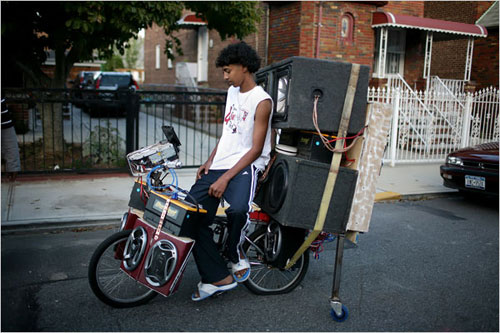
Bicycle Sound Systems (BSS) are growing in popularity. Anyone who has gone to a festival, seen or participated in a Critical Mass ride or watched the Skyride events in the UK will have seen a BSS in operation. The following is a description of what I have learnt over the years in the art of building a sound system attached to a bicycle.
Please note that all this is just my opinion; there are no rules. If it works and you or someone else is happy with the result then that is great. Duke Ellington once said, "There are two types of music, good and bad. If you like it, it's good music."
The first consideration before building a bicycle sound system is to ask yourself exactly what is it for? Now this may sound like a stupid question but consider:
Is the music for your own enjoyment, other cyclists riding with you, or members of the public watching?
Will you be riding the bike whilst the music is playing? (probably answered in the first question)
Would you like to play just your own music or have facilities, i.e. mixing desk, microphones, to make the system more flexible?
Would you wish to hire out the system at festivals and other events?
Where would the system be stored when not in use?
How would you get the system to the events?
Hopefully you can see the reason for asking these questions first. Once you know what the BSS is for, there are now a few more questions.
What is the budget?
How loud is the system to be?
Will you want to operate it in the rain?
Is it to be self-powered?
Would you want to use a trailer?
I am going to presume that the BSS is designed to have the music playing whilst being ridden. I have seen 'static' systems but I feel the whole idea of a BSS is that we have mobile music.
A top of the range BSS could run into thousands of pounds, especially if everything needed was bought new.
The volume of the system is probably the key to everything. The amount of power needed outside is far, far more than is needed inside; most of the sound from speakers inside a building is actually reflected sound. Take the walls away and the volume drops massively.
There has to be a balance between what is audible, the fidelity of the reproduction, what can be afforded, and what is practical. A super loud system can not only annoy the neighbourhood and attract the police but it becomes really heavy and is impossible to move. Remember there is not just the weight of the speakers, there are also batteries and amplifiers that have to be carried.
Again, how loud depends on the use, if it is just yourself and a cyclist next to you, 50 - 100 watts could be enough. In my opinion, 100 watts would be the absolute minimum. If you want many people to hear you and you want a proper bass response, the wattage must increase. I believe 600 watts is somewhere around the maximum, for both volume and weight.
Critically the amplifier must not be overdriven. This usually happens when the output of the amplifier is not enough for the situation. Everything is turned to max to compensate and there is distortion. We have all heard it, in cars, clueless DJ's, PA systems... The crazy thing is that turning it down just a bit will reduce the volume very slightly but everything can now be heard properly without distortion.
The question of waterproofing has to be considered from the outset. Placing plastic bags or sheeting over speakers, amps and players does not work; not only does it look terrible, water WILL get in. Another issue is at what point do the covers go on? In case it looks like rain or when it starts raining? The latter means carrying covers to hopefully quickly throw over the system (whilst it is running!) in the hope that nothing gets damaged. Although there are waterproof players out there, the connections are not waterproof. Waterproof speakers do not sound that good, they are small and low powered. I have never seen a waterproof amplifier.
Self -powered or not? This will come down to the volume of the system. An average cyclist can develop 100-200 watts for an hour. Moving the bike and sound system is going to use a certain amount of that power. There are losses involved in converting that power to usable electricity. Taking these factors into account, never mind the engineering problems in generating the electricity, we do not have much left for powering the amplifier. It can and has been done, the systems are not that loud and, in my opinion, are not that good.
Whether or not to use a trailer is again down to what the BSS is for. We have all seen the ghetto-blaster strapped to the side of a bicycle. It works but the sound is not too good and cannot be heard from more than a few metres away.
The main problem with getting a decent sound without a trailer is one of weight. That is why all the good sound systems I have seen use a trailer.
If it is decided that batteries will power the system, we then consider the amplifier. Although the best amplifiers, in terms of fidelity are the domestic, Hi-Fi amps, they run on mains, 110v or 240v AC. This means the battery voltage, most likely 12v DC, must be converted.
This causes all sorts of problems. The worst is that cheaper converters, or inverters, convert the DC into a square wave AC, this makes an amplifier hum. The other problem is the idea of having high voltages running around the system.
Even if these considerations were overcome, the next, probably terminal issue is that a domestic or PA amplifier would probably fall apart in a short time due to the battering bicycle sound systems get. And they do get a battering; cobbles, pot holes, kerbs, speed humps, all give these rigs a hard life.
These reasons are why every BSS I have seen use 12v automotive amplifiers; they are relatively cheap, easy to bolt down and provided a reputable make is used, are very reliable.
The fidelity of an amplifier on a BSS is not that critical. What is discernable inside a quiet living room will be lost outside. As long as there is no distortion, the most critical component of a bicycle sound system is the speaker(s)
The most important consideration when building any music system, whether a domestic Hi-Fi, car audio system, or public address (PA) is the choice of speakers. Over half your budget should go on the speakers. If top quality speakers are used, you can get away, to a certain extent, with cheaper amplifiers. Do it the other way round and there will always be a poor sound.
Speakers are difficult to get right. The different drivers, e.g. woofer, tweeter, must be matched with each other and they also must be matched with the correct crossover (the device that splits the signal into high and low frequencies). Not only that, the cabinet, or enclosure must also be matched to the drivers and the crossover.
A sound engineer told me that he once worked for a top speaker manufacturer in the UK. His first project was to discover why their latest speaker did not work as well as their previous model. In theory it should have sounded better but mysteriously sounded worse. After a week of messing about he discovered that the screws holding the rear cover on were slightly shorter in the new speaker. Changing the screws for the longer ones magically brought the speaker to life.
It is that story alone that makes the idea of building a speaker from DIY plans very much hit or miss. Yes, the speaker will work but will it sound fantastic, just OK or dreadful? The only advantage of building a speaker cabinet is that it could be made to fit a trailer, or be an integral part of the trailer.
The choice of speakers is massive. Generally, speakers can be divided into three types, Hi-Fi, car audio and PA.
Car speakers can be a popular choice for BSS as they are cheap. The biggest problem with them is that they have to be fitted into a cabinet. Often seen is the 'sub' bass, a 15" speaker already fitted into a cabinet. The problem is that a 'sub' bass is just that, subsonic, or very low frequencies only. Great for certain types of music and a cinema surround sound system but not good enough on its own for a sound system. There will be a need for proper bass drivers as well as a sub. Generally a sub is not needed, not only does it require huge amounts of power to drive it, most music sounds good without one.
Hi-Fi speakers can and are used. The disadvantages with them are:
To mount them properly they must either be strapped or screwed down. Screwing them means introducing screws into the cabinet, the cabinets are not designed for this and the material can be weakened. Also see above for the effect of the 'wrong' screws.
They are meant to be used in static situations. The electronic crossovers in them are not rugged enough for mobile use and can fail.
They are vunerable to damage.
The connections are unreliable for a mobile application.
I believe the best speaker for a BSS are professional PA speakers for the following reasons:
They are very robust, built for a life on the road. The cabinets are usually made from tough ABS plastic and the speakers have protective grills over them.
They often have handles built into them which makes assembling and transporting the system easier.
The crossovers are built in and are made for rough use and to handle high power.
They have professional Speakon connectors, these are very quick to connect and cannot work loose.
A speaker from a quality manufacturer will have designed the drivers to work well together at high wattages reliably
The cabinets usually have threaded inserts making it easy to fix them to a trailer. (remember the story about the wrong screws; start screwing into a domestic Hi-Fi speaker at your peril. That is why speaker wall brackets just clamp onto the speaker).
Another aspect of speaker choice comes back to the intended use. Stereo or mono? Stereo only works when the speakers are in the correct position in front of the listener. This is not going to happen with a BSS. Another consideration is placement. Front, side or rear facing?
An advantage of a mono sound is that the amplifier can be bridged. Most car amplifiers can be bridged. Bridging an amplifier has the effect of increasing the output of the amplifier. When bridging an amplifier into two speaker cabinets, extreme care must be taken to ensure the impedance of the combined speakers does not go below the minimum rated impedance of the amplifier otherwise a sorry mess of blue smoke will ensue.
Having carefully chosen the amplifier and speakers. The question of getting it all to fit together must be considered.
There is the choice of trailer and battery. The trailer often comes down to budget and availability. Just make sure it is strong enough to support the combined weight of everything.
Do not use 12v car batteries. They are designed to give a large current in a short burst to operate the starter motor. They are not designed to go flat - a flat battery is anything less than about 12.5 volts. Once they have gone flat they will never recover. Each re-charge will result in a lower and lower final voltage until the battery will fail.
The cheapest form of usable battery is the lead acid 'leisure battery'. These are designed for caravans and wind charger and photo-voltaic systems; they can be re-cycled (recharged) many times before failure.
Always use a fuse after the battery!
Use proper crimped connectors, battery terminals etc. Try to avoid jamming wire under bolts. The vast majority of failures in all electrical systems are loose or bad connections.
Try to use locking compound on screws and other fittings.
Large output amplifiers that are bridged running in an enclosed space can be prone to overheating. A good amplifier will have an automatic shut-down if this happens. Overheating can be easily avoided by using computer cooling fans blowing across the amplifier. Stick-on heat sinks can help. Computer fans operate at 12v and can be found very cheaply on eBay.
Put all the electrics into an enclosure that is waterproof. Have an air inlet at the bottom to let cool air in and an outlet at the top for the warm air to escape.
The speakers can be protected by a cover over the top and some sort of material (printed fabrics are cheap and look good) across the front of them. As long as the material is a few inches from the front of the speakers they will remain dry.
The music player for simplicity and water protection can be mounted near the amplifier. The obvious disadvantage is that it cannot be controlled from the bike. One solution is to mount it in a small box on the handle bars. We have found the best way is to use a plastic lidded box turned upside down with the box attached to the lid with a hinge. As long as the player is mounted above the base (lid) it will remain dry. Obviously if it is raining hard try to avoid opening the box!
Finally, appearance. Briefly, if the system is just to please you and your friends probably the last thing to worry about is its appearance. After all, there is something to be said about the aesthetics of a functional device. However, if you want to hire the system out or use it on paid-for events, the appearance can be a more important consideration than its performance.
By Clive Britton
Please note that all this is just my opinion; there are no rules. If it works and you or someone else is happy with the result then that is great. Duke Ellington once said, "There are two types of music, good and bad. If you like it, it's good music."
The first consideration before building a bicycle sound system is to ask yourself exactly what is it for? Now this may sound like a stupid question but consider:
Is the music for your own enjoyment, other cyclists riding with you, or members of the public watching?
Will you be riding the bike whilst the music is playing? (probably answered in the first question)
Would you like to play just your own music or have facilities, i.e. mixing desk, microphones, to make the system more flexible?
Would you wish to hire out the system at festivals and other events?
Where would the system be stored when not in use?
How would you get the system to the events?
Hopefully you can see the reason for asking these questions first. Once you know what the BSS is for, there are now a few more questions.
What is the budget?
How loud is the system to be?
Will you want to operate it in the rain?
Is it to be self-powered?
Would you want to use a trailer?
I am going to presume that the BSS is designed to have the music playing whilst being ridden. I have seen 'static' systems but I feel the whole idea of a BSS is that we have mobile music.
A top of the range BSS could run into thousands of pounds, especially if everything needed was bought new.
The volume of the system is probably the key to everything. The amount of power needed outside is far, far more than is needed inside; most of the sound from speakers inside a building is actually reflected sound. Take the walls away and the volume drops massively.
There has to be a balance between what is audible, the fidelity of the reproduction, what can be afforded, and what is practical. A super loud system can not only annoy the neighbourhood and attract the police but it becomes really heavy and is impossible to move. Remember there is not just the weight of the speakers, there are also batteries and amplifiers that have to be carried.
Again, how loud depends on the use, if it is just yourself and a cyclist next to you, 50 - 100 watts could be enough. In my opinion, 100 watts would be the absolute minimum. If you want many people to hear you and you want a proper bass response, the wattage must increase. I believe 600 watts is somewhere around the maximum, for both volume and weight.
Critically the amplifier must not be overdriven. This usually happens when the output of the amplifier is not enough for the situation. Everything is turned to max to compensate and there is distortion. We have all heard it, in cars, clueless DJ's, PA systems... The crazy thing is that turning it down just a bit will reduce the volume very slightly but everything can now be heard properly without distortion.
The question of waterproofing has to be considered from the outset. Placing plastic bags or sheeting over speakers, amps and players does not work; not only does it look terrible, water WILL get in. Another issue is at what point do the covers go on? In case it looks like rain or when it starts raining? The latter means carrying covers to hopefully quickly throw over the system (whilst it is running!) in the hope that nothing gets damaged. Although there are waterproof players out there, the connections are not waterproof. Waterproof speakers do not sound that good, they are small and low powered. I have never seen a waterproof amplifier.
Self -powered or not? This will come down to the volume of the system. An average cyclist can develop 100-200 watts for an hour. Moving the bike and sound system is going to use a certain amount of that power. There are losses involved in converting that power to usable electricity. Taking these factors into account, never mind the engineering problems in generating the electricity, we do not have much left for powering the amplifier. It can and has been done, the systems are not that loud and, in my opinion, are not that good.
Whether or not to use a trailer is again down to what the BSS is for. We have all seen the ghetto-blaster strapped to the side of a bicycle. It works but the sound is not too good and cannot be heard from more than a few metres away.
The main problem with getting a decent sound without a trailer is one of weight. That is why all the good sound systems I have seen use a trailer.
If it is decided that batteries will power the system, we then consider the amplifier. Although the best amplifiers, in terms of fidelity are the domestic, Hi-Fi amps, they run on mains, 110v or 240v AC. This means the battery voltage, most likely 12v DC, must be converted.
This causes all sorts of problems. The worst is that cheaper converters, or inverters, convert the DC into a square wave AC, this makes an amplifier hum. The other problem is the idea of having high voltages running around the system.
Even if these considerations were overcome, the next, probably terminal issue is that a domestic or PA amplifier would probably fall apart in a short time due to the battering bicycle sound systems get. And they do get a battering; cobbles, pot holes, kerbs, speed humps, all give these rigs a hard life.
These reasons are why every BSS I have seen use 12v automotive amplifiers; they are relatively cheap, easy to bolt down and provided a reputable make is used, are very reliable.
The fidelity of an amplifier on a BSS is not that critical. What is discernable inside a quiet living room will be lost outside. As long as there is no distortion, the most critical component of a bicycle sound system is the speaker(s)
The most important consideration when building any music system, whether a domestic Hi-Fi, car audio system, or public address (PA) is the choice of speakers. Over half your budget should go on the speakers. If top quality speakers are used, you can get away, to a certain extent, with cheaper amplifiers. Do it the other way round and there will always be a poor sound.
Speakers are difficult to get right. The different drivers, e.g. woofer, tweeter, must be matched with each other and they also must be matched with the correct crossover (the device that splits the signal into high and low frequencies). Not only that, the cabinet, or enclosure must also be matched to the drivers and the crossover.
A sound engineer told me that he once worked for a top speaker manufacturer in the UK. His first project was to discover why their latest speaker did not work as well as their previous model. In theory it should have sounded better but mysteriously sounded worse. After a week of messing about he discovered that the screws holding the rear cover on were slightly shorter in the new speaker. Changing the screws for the longer ones magically brought the speaker to life.
It is that story alone that makes the idea of building a speaker from DIY plans very much hit or miss. Yes, the speaker will work but will it sound fantastic, just OK or dreadful? The only advantage of building a speaker cabinet is that it could be made to fit a trailer, or be an integral part of the trailer.
The choice of speakers is massive. Generally, speakers can be divided into three types, Hi-Fi, car audio and PA.
Car speakers can be a popular choice for BSS as they are cheap. The biggest problem with them is that they have to be fitted into a cabinet. Often seen is the 'sub' bass, a 15" speaker already fitted into a cabinet. The problem is that a 'sub' bass is just that, subsonic, or very low frequencies only. Great for certain types of music and a cinema surround sound system but not good enough on its own for a sound system. There will be a need for proper bass drivers as well as a sub. Generally a sub is not needed, not only does it require huge amounts of power to drive it, most music sounds good without one.
Hi-Fi speakers can and are used. The disadvantages with them are:
To mount them properly they must either be strapped or screwed down. Screwing them means introducing screws into the cabinet, the cabinets are not designed for this and the material can be weakened. Also see above for the effect of the 'wrong' screws.
They are meant to be used in static situations. The electronic crossovers in them are not rugged enough for mobile use and can fail.
They are vunerable to damage.
The connections are unreliable for a mobile application.
I believe the best speaker for a BSS are professional PA speakers for the following reasons:
They are very robust, built for a life on the road. The cabinets are usually made from tough ABS plastic and the speakers have protective grills over them.
They often have handles built into them which makes assembling and transporting the system easier.
The crossovers are built in and are made for rough use and to handle high power.
They have professional Speakon connectors, these are very quick to connect and cannot work loose.
A speaker from a quality manufacturer will have designed the drivers to work well together at high wattages reliably
The cabinets usually have threaded inserts making it easy to fix them to a trailer. (remember the story about the wrong screws; start screwing into a domestic Hi-Fi speaker at your peril. That is why speaker wall brackets just clamp onto the speaker).
Another aspect of speaker choice comes back to the intended use. Stereo or mono? Stereo only works when the speakers are in the correct position in front of the listener. This is not going to happen with a BSS. Another consideration is placement. Front, side or rear facing?
An advantage of a mono sound is that the amplifier can be bridged. Most car amplifiers can be bridged. Bridging an amplifier has the effect of increasing the output of the amplifier. When bridging an amplifier into two speaker cabinets, extreme care must be taken to ensure the impedance of the combined speakers does not go below the minimum rated impedance of the amplifier otherwise a sorry mess of blue smoke will ensue.
Having carefully chosen the amplifier and speakers. The question of getting it all to fit together must be considered.
There is the choice of trailer and battery. The trailer often comes down to budget and availability. Just make sure it is strong enough to support the combined weight of everything.
Do not use 12v car batteries. They are designed to give a large current in a short burst to operate the starter motor. They are not designed to go flat - a flat battery is anything less than about 12.5 volts. Once they have gone flat they will never recover. Each re-charge will result in a lower and lower final voltage until the battery will fail.
The cheapest form of usable battery is the lead acid 'leisure battery'. These are designed for caravans and wind charger and photo-voltaic systems; they can be re-cycled (recharged) many times before failure.
Always use a fuse after the battery!
Use proper crimped connectors, battery terminals etc. Try to avoid jamming wire under bolts. The vast majority of failures in all electrical systems are loose or bad connections.
Try to use locking compound on screws and other fittings.
Large output amplifiers that are bridged running in an enclosed space can be prone to overheating. A good amplifier will have an automatic shut-down if this happens. Overheating can be easily avoided by using computer cooling fans blowing across the amplifier. Stick-on heat sinks can help. Computer fans operate at 12v and can be found very cheaply on eBay.
Put all the electrics into an enclosure that is waterproof. Have an air inlet at the bottom to let cool air in and an outlet at the top for the warm air to escape.
The speakers can be protected by a cover over the top and some sort of material (printed fabrics are cheap and look good) across the front of them. As long as the material is a few inches from the front of the speakers they will remain dry.
The music player for simplicity and water protection can be mounted near the amplifier. The obvious disadvantage is that it cannot be controlled from the bike. One solution is to mount it in a small box on the handle bars. We have found the best way is to use a plastic lidded box turned upside down with the box attached to the lid with a hinge. As long as the player is mounted above the base (lid) it will remain dry. Obviously if it is raining hard try to avoid opening the box!
Finally, appearance. Briefly, if the system is just to please you and your friends probably the last thing to worry about is its appearance. After all, there is something to be said about the aesthetics of a functional device. However, if you want to hire the system out or use it on paid-for events, the appearance can be a more important consideration than its performance.
By Clive Britton
Langganan:
Komentar (Atom)